Golf Towels: The Complete Buyer's Guide
Everything that actually matters when choosing a golf towel — fabric weave, GSM, size, attachment method, and how many you should carry. Plus the mistakes that leave you wiping a wet clubface with a wet towel.
Most golfers buy a towel the way they buy tees — grab whatever's at the counter, throw it in the bag, never think about it again. Then they spend four hours wiping a muddy 7-iron with a soaked rag that hasn't been dry since the third hole.
A golf towel is one of the few pieces of equipment that touches every single shot you play. It's worth ten minutes of thought.
What is a golf towel?
A golf towel is a small, absorbent towel designed to clean clubfaces, grooves, golf balls, and grips during a round. It's usually 15x15 to 16x24 inches — smaller than a gym towel, larger than a washcloth — and attaches to your bag or cart so it's reachable without setting anything down.
That's the mechanical definition. The functional one is more useful: a golf towel is a dirt-removal and moisture-management tool. Dirt in your grooves costs you spin, which costs you control on approach shots. Moisture on your grips costs you the ability to hold the club without squeezing. A towel that does neither job well is dead weight clipped to your bag.
What is a golf towel for, specifically?
Four jobs, in rough order of how much they affect your score:
1. Clearing grooves. A wedge with packed grooves loses a meaningful amount of spin. On a half-wedge into a firm green, that's the difference between a ball that checks and one that releases into the back bunker. This requires an abrasive or textured surface — and often water.
2. Drying grips. Wet or sweaty grips force a tighter grip pressure, which is one of the fastest ways to lose clubhead speed and start blocking shots right. This requires a genuinely dry section of towel, which is why the wet/dry system below matters.
3. Cleaning the ball. Mud on a ball changes its flight in ways nobody can predict. On the green, a clean ball rolls truer.
4. Drying your hands and face. Underrated in July. A soaked towel can't do this.
Fabric: the only three that matter
Microfiber
Split polyester/polyamide fibers with enormous surface area. Microfiber is the default for a reason — it absorbs several times its weight in water, releases dirt readily, and dries fast. Look at GSM (grams per square meter), which is the closest thing the category has to a spec sheet. Under 300 GSM is thin and cheap. 400–600 GSM is the sweet spot: absorbent without being a brick. Above 700 GSM feels luxurious and takes forever to dry.
Waffle weave
A microfiber (or cotton) towel woven into a raised grid. The pockets do two things: they hold more water per square inch, and the raised ridges physically scrub grooves rather than just wiping them. Waffle is the best-performing texture for actual club cleaning, which is why it has taken over the premium end of the category. The tradeoff is that a waffle towel feels less plush than a plush microfiber and can be slightly rougher on a face you're drying.
Cotton / terry
Classic tour-caddie material. Cotton is soft, cheap, and handles hot water and bleach well, so it launders forever. It's also heavy when wet, slow to dry, and sheds lint into grooves. Fine as a dedicated wet towel, poor as your only towel.
Size and format
- 15x15 to 16x16 — the standard clip-on square. Enough surface for a round if you fold it into quarters and rotate.
- 16x24 to 16x40 (tri-fold) — the caddy towel. Folds into thirds so you always have a dry panel; this is what tour caddies carry. More towel means more dry surface, which is the entire point.
- Utility / oversized — 20x40 and up, usually for cart golf or wet-weather rounds where you're drying a bag as much as a club.
If you only carry one towel, a tri-fold caddy towel is the more capable choice. If you're a walker counting ounces, a 16x16 waffle is the better ratio of function to bulk.
Attachment: the part everyone gets wrong
This is where most towels fail, and it has nothing to do with fabric.
Grommet + carabiner. A metal ring punched into the corner with a clip through it. Cheap, universal, and the failure point is the grommet — it tears out of the fabric eventually, usually mid-season. Also, a clipped towel hangs, drags, and picks up dirt off the cart floor.
Center hole. A slit in the middle of the towel that slides over a bag strap or cart bar. Secure. Annoying to remove one-handed.
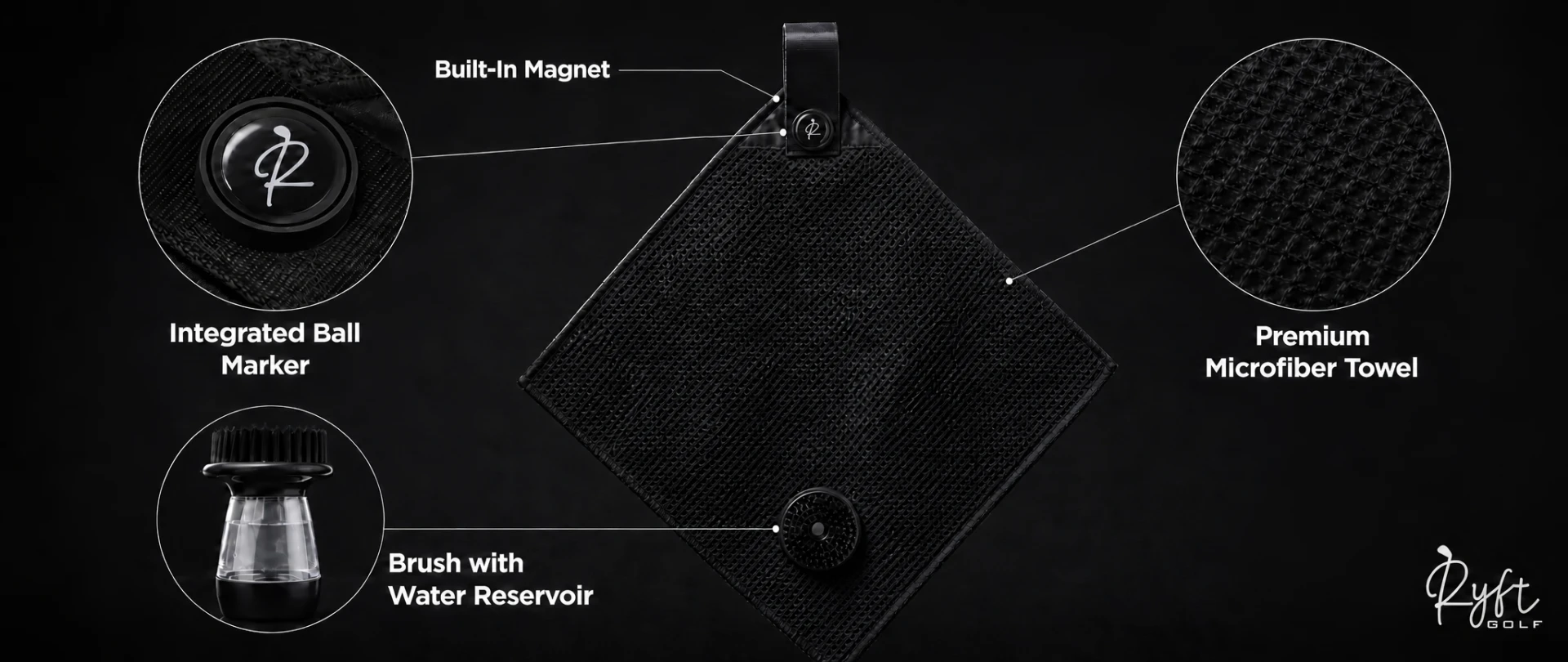
Magnetic. Neodymium magnets sewn into the towel body, letting it slap onto a cart frame, bag rail, or club shaft. This is the format that has grown fastest in the last few years, and the reason is ergonomic rather than technical: you can pull the towel off with one hand, use it, and put it back without looking or fumbling with a clip. The tradeoff is that magnet strength varies enormously between brands, and a weak magnet on a bumpy cart path means a towel in the fairway. We break down magnetic towels in detail here.
The wet/dry system (the thing that actually changes your round)
Here's the mistake almost everyone makes: one towel, soaked at the water station on the first tee, used for everything.
By hole four it's uniformly damp. Now you're smearing water on grips and pushing wet dirt around your grooves.
The fix is embarrassingly simple. Carry two towels, or one towel with genuinely separate zones.
- Wet towel: dampened, used for grooves, ball, and shoes. Lives on the outside of the bag.
- Dry towel: never touches water. Used for grips, hands, and drying a face after the wet towel has scrubbed it.
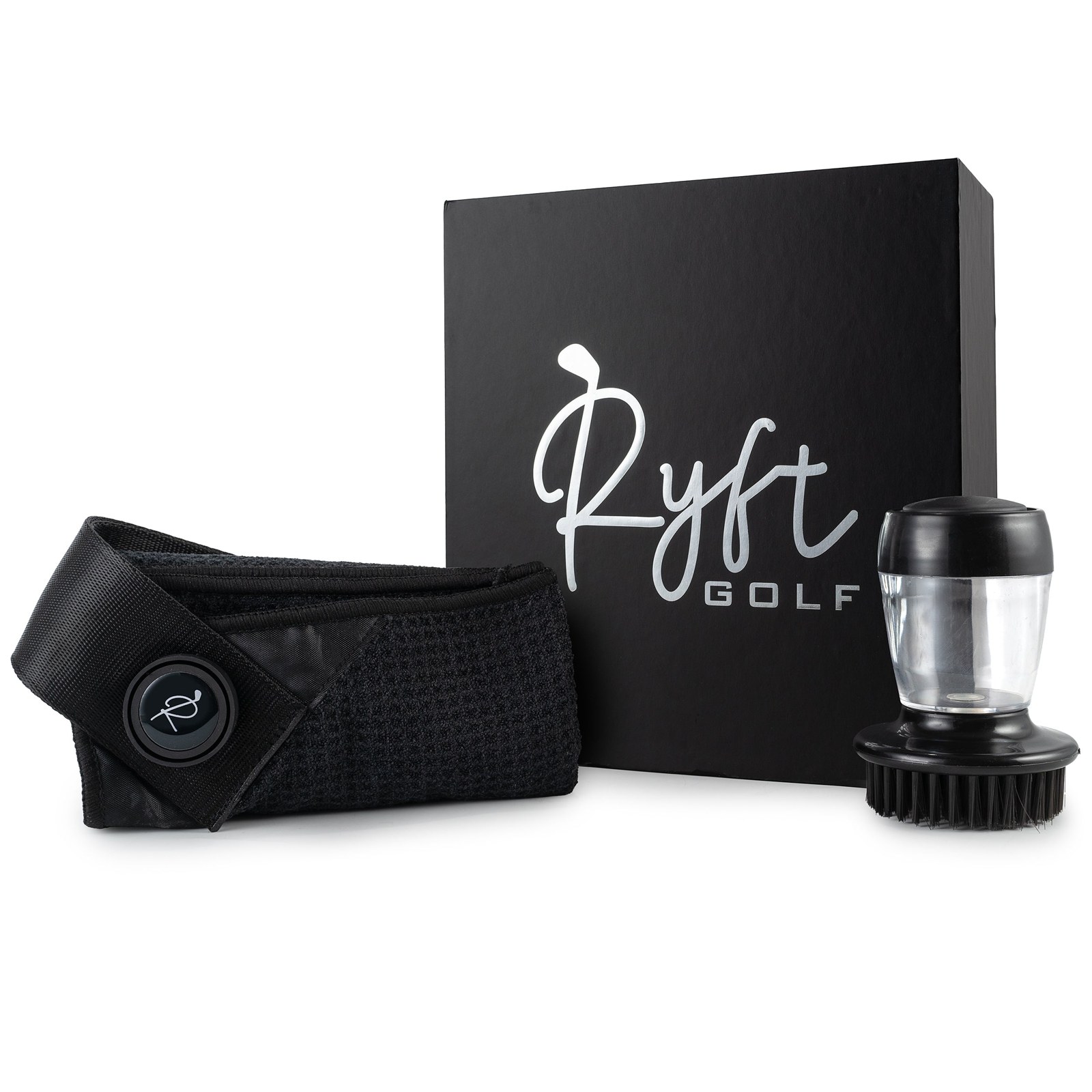
Tri-fold caddy towels approximate this by folding — outer panel wet, inner panels dry. Some newer designs solve it structurally: the Ryft towel, for example, uses a built-in refillable water reservoir feeding a nylon brush, so the water goes into the brush that's doing the scrubbing rather than into the towel that's supposed to stay dry. Same principle, one less thing clipped to the bag.
What a golf towel should cost
Prices move, so treat these as bands rather than quotes.
- Budget — a plain microfiber square with a carabiner. Works. Grommet will fail. Fine as a spare or a dedicated wet towel.
- Mid — waffle weave, decent GSM, magnetic or reinforced attachment. This is where the meaningful jump in quality happens, and where most golfers should land.
- Premium — tri-fold caddy towels, heavy waffle, integrated tools, or custom embroidery. Worth it if you play weekly and hate carrying four separate accessories.
Anything above that band is buying a logo, which is a completely legitimate thing to buy — just know that's what you're doing.
How many towels should you carry?
Two is the honest answer for most golfers: one wet, one dry. Three if you play in the Southeast in August, or if you want a dedicated shoe towel that never touches a clubface.
If carrying two towels annoys you, the alternative is a single towel that separates its wet and dry functions structurally — a brush-and-reservoir design, or a tri-fold you're disciplined about. What doesn't work is one square microfiber towel doing all four jobs.
Care: how to not ruin a good towel
- Wash microfiber alone, or at least away from cotton. Cotton lint clogs the microfiber and kills absorbency permanently.
- No fabric softener. Ever. Softener coats the fibers and destroys the exact property you paid for.
- Low heat or air dry. High heat melts polyester fibers into a flat, non-absorbent sheet.
- Skip the bleach on microfiber (fine on cotton).
- Don't leave it wet in the bag. That's how a towel starts to smell and how a bag pocket grows mildew.
Do these four things and a good towel lasts several seasons instead of one.
FAQ
What is a golf towel used for?
Cleaning clubface grooves, wiping mud off the ball, drying grips and hands, and cleaning shoes. Grooves and grips are the two that measurably affect ball flight — packed grooves reduce spin, and wet grips force you to squeeze the club.
Should a golf towel be wet or dry?
Both, which is why the standard advice is to carry two. Use a damp towel for grooves and the ball; keep a completely dry one for grips and hands. Using a single damp towel for everything is the most common towel mistake in golf.
What size golf towel is best?
16x16 inches for a clip-on square, or 16x24 to 16x40 for a tri-fold caddy towel. Larger towels give you more dry surface area, which is the whole reason caddies carry the long ones.
Is waffle or microfiber better for golf?
They're not opposites — most waffle golf towels are microfiber woven into a waffle grid. Compared to flat plush microfiber, waffle scrubs grooves better and holds more water; flat microfiber is softer and slightly better for drying hands. For club cleaning, waffle wins.
Are magnetic golf towels worth it?
If the magnet is strong enough, yes — one-handed grab-and-replace is a genuine improvement over fumbling with a carabiner. Weak magnets are worse than useless because you'll lose the towel. Check magnet count and placement before buying.
How do I keep my golf towel from getting filthy?
Don't let it hang low enough to drag on cart floors or wet grass, carry a separate shoe towel, and wash it after every two or three rounds. Most towels look ruined not because they're worn out but because they've been washed with fabric softener.